Effectiveness of Read Write Inc Case Study
Updated: March 2022
First published: July 2020
Share on: Twitter / Facebook
An overview of the current evidence regarding the effectiveness of face up masks.
Contents
A) Studies ⇓ B) WHO review ⇓ C) Existent-world evidence ⇓ D) N95/FFP2 masks ⇓ E) Boosted aspects ⇓ F) The aerosol issue ⇓ Thousand) Contrary evidence ⇓ H) Mask-related risks ⇓ I) Conclusion ⇓
A) Studies on the effectiveness of face masks
So far, near studies establish little to no show for the effectiveness of face masks in the general population, neither as personal protective equipment nor every bit a source command.
- A May 2020 meta-study on pandemic influenza published by the US CDC found that face masks had no effect, neither every bit personal protective equipment nor as a source control. (Source)
- A WHO review of ten randomized controlled trials of face masks confronting flu-like illness, published in September 2019, found no statistically significant benefit. (Source)
- A Danish randomized controlled trial with 6000 participants, published in the Annals of Internal Medicine in Nov 2020, found no statistically pregnant effect of high-quality medical face masks against SARS-CoV-two infection in a community setting. (Source)
- A large randomized controlled trial with close to 8000 participants, published in October 2020 in PLOS Ane, constitute that face masks "did not seem to be constructive confronting laboratory-confirmed viral respiratory infections nor against clinical respiratory infection." (Source)
- A February 2021 review past the European CDC found no high-quality evidence in favor of face masks and recommended their use but based on the 'precautionary principle'. (Source)
- A July 2020 review by the Oxford Eye for Show-Based Medicine establish that there is no evidence for the effectiveness of face up masks against virus infection or transmission. (Source)
- A November 2020 Cochrane review institute that confront masks did non reduce influenza-similar illness (ILI) cases, neither in the general population nor in health intendance workers. (Source)
- An Baronial 2021 study published in the Int. Research Journal of Public Health found "no association between mask mandates or use and reduced COVID-19 spread in United states of america states." (Source)
- A July 2021 experimental written report published by the American Establish of Physics found that confront masks reduced indoor aerosols by at nearly 12% and even increased them locally. (Source)
- A May 2020 article past researchers from Harvard Medical Schoolhouse, published in the New England Periodical of Medicine, concluded that face masks offer "little, if any, protection". (Source)
- A 2015 study in the British Medical Periodical BMJ Open up found that fabric masks were penetrated by 97% of particles and may increase infection hazard past retaining moisture or repeated use. (Source)
- An August 2020 review past a German professor in virology, epidemiology and hygiene institute that there is no evidence for the effectiveness of face masks and that the improper daily use of masks by the public may in fact lead to an increase in infections. (Source)
For a review of studies claiming face masks are effective, see section G) beneath.
B) WHO review of confront mask trials (2019)
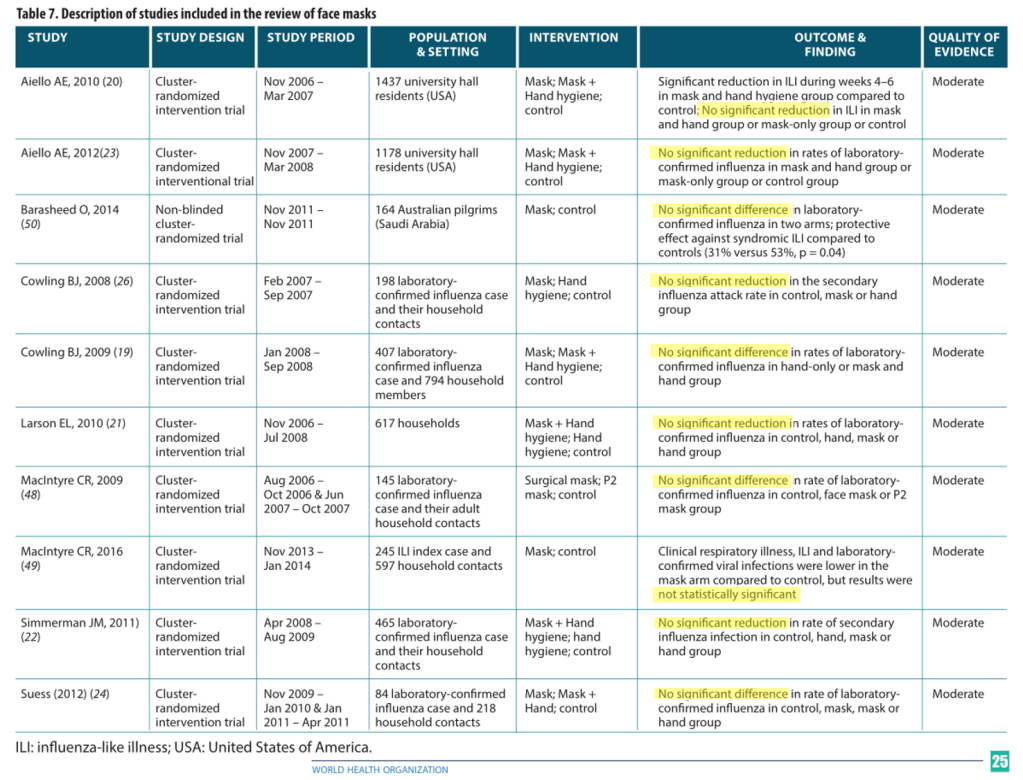
In September 2019, before long earlier the coronavirus pandemic, the Globe Health Organization (WHO) published a comprehensive report on "Non-pharmaceutical public health measures for mitigating the risk and affect of epidemic and pandemic influenza".
The report reviewed ten randomized controlled trials concerning the effectiveness of face masks against flu-like illness (ILI). As the following table shows, none of the trials found a statistically significant benefit of face masks.
C) Evolution of cases after mask mandates
In many states, coronavirus infections strongly increased after mask mandates had been introduced. The following charts show the typical examples of Austria, Belgium, French republic, Germany, Ireland, Italian republic, Kingdom of spain, the Uk, California and Hawaii. Furthermore, a direct comparing betwixt U.s.a. states with and without mask mandates indicates that mask mandates have made no divergence. (Charts: Y. Weiss)
For an updated version of these charts, see the postscript below.
D) Effectiveness of N95/FFP2 mask mandates
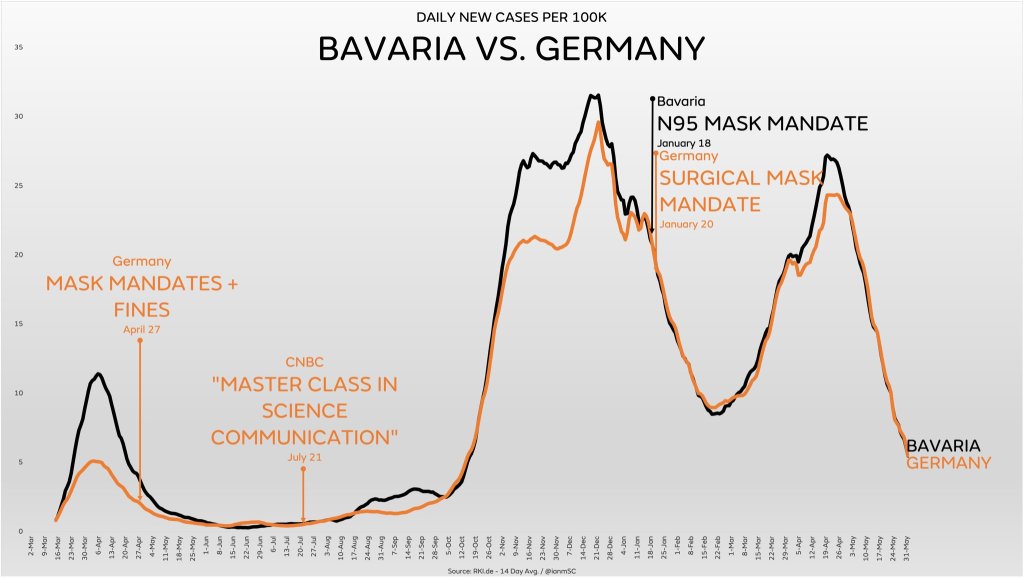
In Jan 2021, the German state of Bavaria was one of the showtime places in the earth to mandate N95/FFP2 masks in nearly public settings. A comparison with other German states, which required cloth or medical masks, indicates that even N95/FFP2 masks take fabricated no departure.
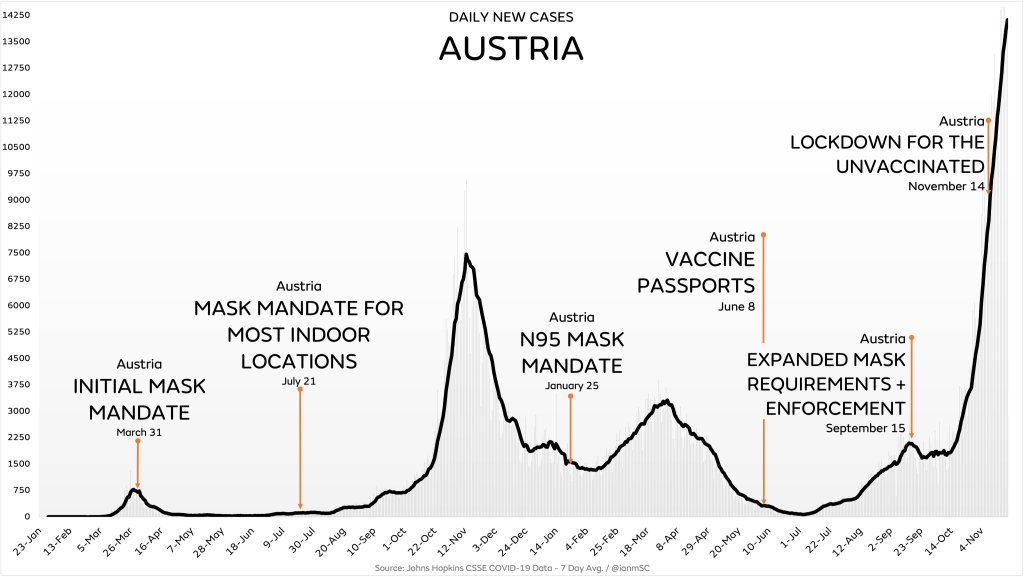
In January 2021, Austria was the kickoff country in the globe to introduce an N95/FFP2 mask mandate at the national level. The mandate was further expanded in September 2021. Nevertheless, by Nov 2021 Austria reported the highest infection rate in the globe.
East) Boosted aspects
- There is increasing evidence that the novel coronavirus is transmitted, at least in indoor settings, not primarily by droplets but by much smaller aerosols. However, due to their large pore size and poor fit, most face masks cannot filter out aerosols (see video analysis below): over ninety% of aerosols penetrate or bypass the mask and fill a medium-sized room within minutes.
- The WHO admitted to the BBC that its June 2020 mask policy update was due not to new evidence simply "political lobbying": "Nosotros had been told past various sources WHO committee reviewing the prove had not backed masks but they recommended them due to political lobbying. This indicate was put to WHO who did not deny." (D. Cohen, BBC Medical Corresponent).
- To engagement, the only randomized controlled trial (RCT) on face masks against SARS-CoV-2 infection in a community setting plant no statistically significant benefit (see above). However, three major journals refused to publish this study, delaying its publication by several months.
- An analysis by the US CDC found that 85% of people infected with the new coronavirus reported wearing a mask "ever" (70.vi%) or "often" (14.4%). Compared to the command group of uninfected people, always wearing a mask did not reduce the hazard of infection.
- Researchers from the Academy of Minnesota constitute that the infectious dose of SARS-CoV-2 is just 300 virions (virus particles), whereas a single minute of normal speaking may generate more than 750,000 virions, making face masks unlikely to prevent infection.
- Opposite to mutual belief, studies in hospitals constitute that the wearing of a medical mask past surgeons during operations didn't reduce post-operative bacterial wound infections in patients.
- Many wellness regime argued that face up masks suppressed influenza; in reality, flu was temporarily displaced by the more infectious coronavirus. Indeed, influenza disappeared fifty-fifty in states without masks, lockdowns and school closures (e.g. Sweden and Florida).
- The initially depression coronavirus infection rate in some Asian countries was not due to masks, only due to very rapid border controls. For instance, Japan, despite its widespread utilise of face masks, had experienced its most recent influenza epidemic just one year prior to the covid pandemic.
- Early in the pandemic, the advocacy group "Mask for All" argued that Czechia had few infections thank you to the early use of masks. In reality, the pandemic simply hadn't reached Eastern Europe all the same; a few months afterward, Czechia had one of the highest infection rates in the globe.
- During the notorious 1918 flu pandemic, the utilize of face masks among the full general population was widespread and in some places mandatory, but they made no divergence.
F) The facemask droplets issue
In the following video, Dr. Theodore Noel explains the facemask aerosol outcome.
1000) Studies claiming face masks are constructive
Some recent studies argued that face masks are indeed effective against the new coronavirus and could at to the lowest degree foreclose the infection of other people. All the same, nigh of these studies suffer from poor methodology and sometimes show the opposite of what they claim to show.
Typically, these studies ignore the effect of other measures, the natural evolution of infection rates, changes in test activity, or they compare places with different epidemiological weather. Studies performed in a lab or equally a computer simulation often aren't applicable to the real world.
An overview:
- A meta-study in the periodical Lancet, commissioned by the WHO, claimed that masks could reduce the risk of infection by fourscore%, but the studies considered mainly N95 respirators in a hospital setting, non fabric masks in a community setting, the forcefulness of the evidence was reported every bit "low", and experts found numerous flaws in the study. Professor Peter Jueni, epidemiologist at the University of Toronto, called the WHO report "substantially useless".
- A study in the journal PNAS claimed that masks had led to a decrease in infections in three global hotspots (including New York City), but the written report did not accept into account the natural decrease in infections and other simultaneous measures. The study was and then flawed that over xl scientists recommended that the study be withdrawn.
- A US written report claimed that The states counties with mask mandates had lower Covid infection and hospitalization rates, but the authors had to withdraw their study as infections and hospitalizations increased in many of these counties soon after the study was published.
- A large study run in People's republic of bangladesh claimed that surgical masks, merely non material masks, reduced "symptomatic SARS-CoV-ii infections" by 0.08% (ARR), and just in people over fifty. But a subsequent re-analysis of the written report by statisticians found that there was in fact no benefit at all. According to i reviewer, the Bangladesh study was designed so poorly that information technology "ended before information technology even began".
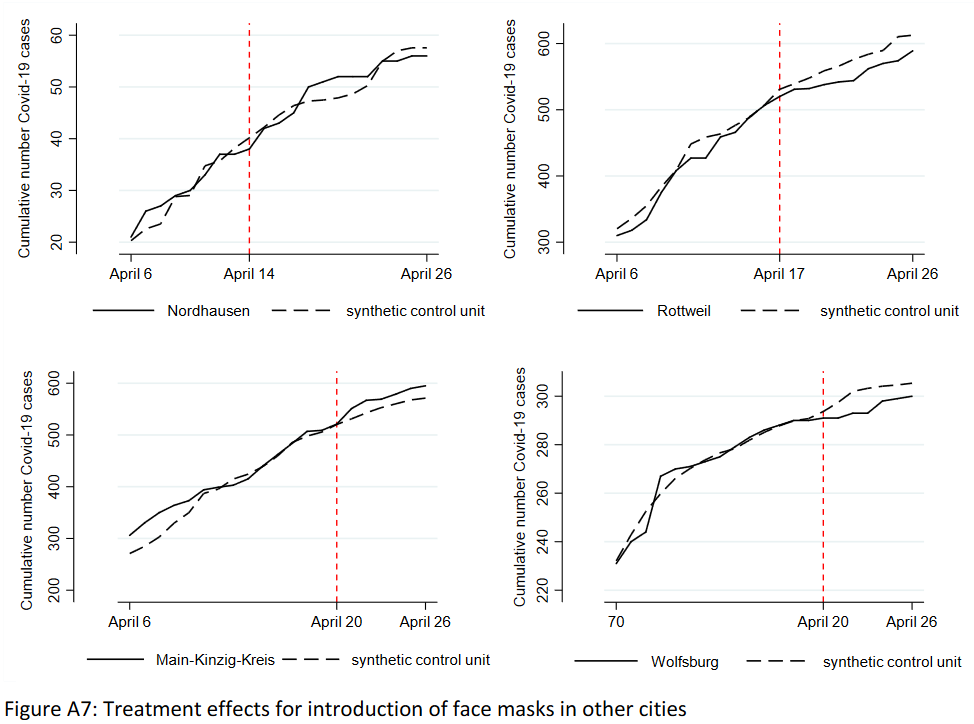
- A German study claimed that the introduction of mandatory face masks in German language cities had led to a meaning decrease in infections. Merely the information did non support this claim: in some cities at that place was no change, in others a decrease, in others an increase in infections (see graph below). The city of Jena was an 'exception' only considering it simultaneously introduced the strictest quarantine rules in Deutschland, only the study did non mention this.
- A review past the University of Oxford claimed that confront masks are constructive, simply information technology was based on studies well-nigh SARS-i and in health intendance settings, not in customs settings.
- A review by members of the anteroom group 'Masks for All', published in the journal PNAS, claimed that masks are effective equally a source command against aerosol transmission in the community, but the review provided no existent-earth evidence supporting this proffer.
- A study published in Nature Communications in June 2021 claimed that masks reduced the risk of infection by 62%, simply the study relied on self-reported online survey results and various modelling assumptions, not on actual measurements.
- A meta-study published in the BMJ claimed face masks reduced infections past 53%, but the meta-study was based on seven depression-quality observational studies. In response, the BMJ published an editorial acknowledging the "lack of good research" and the implausibility of the issue.
- A German study, published in PNAS, claimed that N95/FFP2 masks are highly effective confronting coronavirus infections, but the study consisted simply of a mathematical model without any real-earth or lab data (meet section D to a higher place).
The annex of the German Jena study showed that face up masks weren't effective:
H) Risks associated with face masks
Wearing masks for a prolonged menses of time may non be harmless, as the following evidence shows:
- The WHO warns of various "side effects" such equally difficulty breathing and peel rashes.
- An Israeli-Canadian report, published in Cerebral Inquiry in February 2022, found that "face up masks disrupt holistic processing and face up perception in school-historic period children".
- Tests conducted by the University Hospital of Leipzig in Germany have shown that face masks significantly reduce the resilience and functioning of healthy adults.
- A German psychological study with virtually 1000 participants found "astringent psychosocial consequences" due to the introduction of mandatory face up masks in Frg.
- The Hamburg Environmental Institute warned of the inhalation of chlorine compounds in polyester masks also as problems in connection with confront mask disposal.
- The European rapid warning organisation RAPEX has already recalled over 100 mask models because they did not come across European union quality standards and could lead to "serious risks".
- A study by the University of Muenster in Federal republic of germany found that on N95 (FFP2) masks, Sars-CoV-ii may remain infectious for several days, thus increasing the run a risk of self-contamination.
- In People's republic of china, several children who had to wear a mask during gym classes fainted and died; autopsies found a sudden cardiac abort as the probable cause of death. In the United states, a machine driver wearing an N95 (FFP2) mask fainted and crashed due to CO2 intoxication.
Video: A mask-wearing, 19-twelvemonth-erstwhile US athlete collapsed during an 800-meter run (April 2021):
Conclusion
Face masks in the general population might be constructive, at least in some circumstances, but there is currently fiddling to no testify supporting this proposition. If the coronavirus is primarily transmitted via indoor aerosols, face masks are unlikely to exist protective. Thus, health authorities should non assume or suggest that face masks will reduce the rate or risk of infection.
United States: mask mandates without do good

Postscript (August 2021)
A long-term assay shows that infections accept been driven primarily past seasonal and endemic factors, whereas mask mandates and lockdowns take had no discernible bear on (charts: IanMSC).
Further reading
- The face mask folly in retrospect (August 2021)
Come across likewise
- Facts near covid
- Covid vaccine review
- Treatment of covid
Share on: Twitter / Facebook
Source: https://swprs.org/face-masks-evidence/
0 Response to "Effectiveness of Read Write Inc Case Study"
Post a Comment